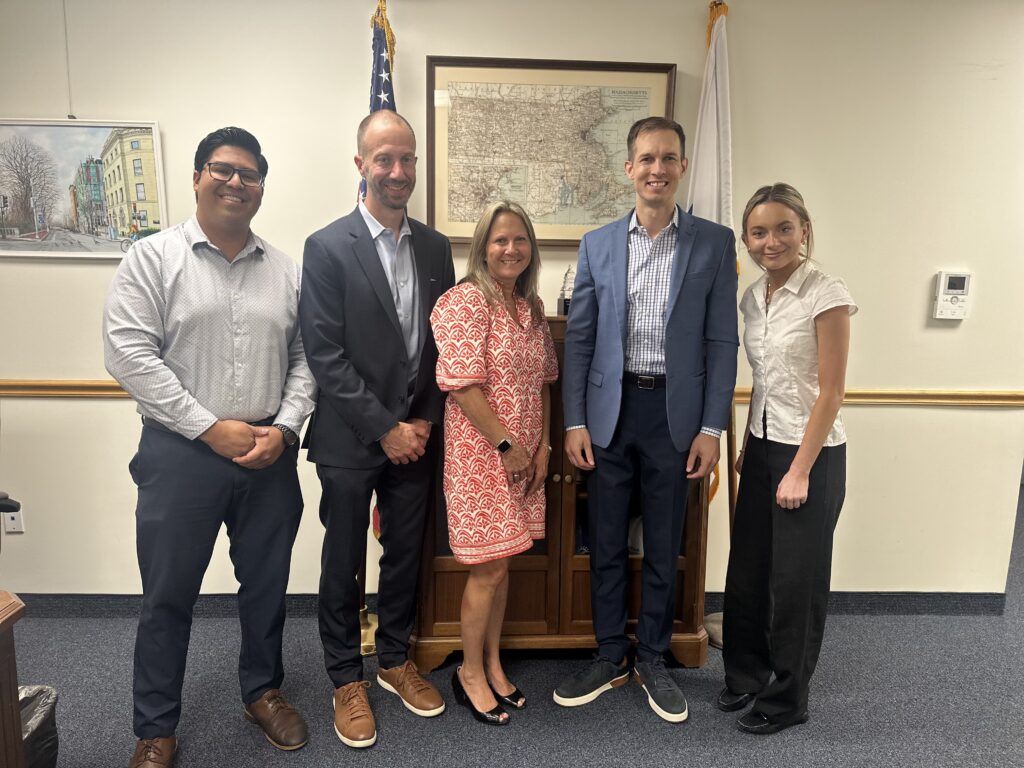
Mass Restaurants United recently met with U.S. Representative Jake Auchincloss, who represents communities including Newton, Brookline, Needham, and surrounding areas, to discuss the ongoing challenges facing independent restaurants and hospitality businesses.
MRU Executive Director Jen Ziskin was joined by Sergio Espinoza, Adam Barnosky, and Grace Nolfi, MRU’s legislative intern, for a conversation focused on the financial and workforce pressures impacting restaurant operators across the region.
The discussion highlighted several urgent concerns, including immigration, affordable housing, credit card processing fees, labor shortages, restaurant profitability, and the lasting effects of COVID-19 on the industry. Restaurant leaders emphasized that approximately 47% of restaurants are currently not profitable, underscoring the financial strain many operators continue to face.
Participants also shared that measuring the health of the restaurant industry only by openings and closures does not tell the full story. Many restaurants remain open while operating on extremely tight margins, making it increasingly difficult to stay sustainable as costs continue to rise.
Immigration policy was also discussed as a major factor affecting the restaurant workforce. Operators noted that current policies make it more difficult to find and retain employees, while affordable housing challenges further impact workers’ ability to live near the communities they serve.
Additional concerns included declining alcohol sales due to changing consumer habits, rising beef costs, and the need for more flexibility and resources to help restaurants adapt. MRU emphasized that additional funding and support would allow businesses to pivot when necessary, instead of simply absorbing losses.
The group also discussed how foot traffic alone can be misleading when evaluating restaurant performance. A busy dining room does not always mean a restaurant is profitable, especially when operating costs continue to increase.
SBA loan accessibility was another key topic. Restaurant leaders raised concerns about barriers that many business owners face, including citizenship requirements and the need to improve access to 504 SBA loans.
MRU also emphasized the importance of expanding grant funding for English language classes, including programs such as English for New Bostonians, which support workers, employers, and the broader hospitality industry.
As a follow-up, Representative Auchincloss requested additional data on restaurant openings and closures within the district. MRU also discussed the possibility of a future roundtable focused on immigration and undocumented workers, with an emphasis on restaurant workers, a cross-section of industry stakeholders, and immigration reform proposals such as the Dignity Act.
MRU appreciates Representative Auchincloss’s time and continued interest in understanding the real challenges facing independent restaurants and the hospitality workforce.